Showing posts with label The Best “New” African Poets 2015 Anthology. Show all posts

Thursday, February 25, 2016

IN DEPTH INTERVIEW SERIES: Week of 22 February 2016

An interview with Mike Kantey and Chuma Mmeka

Pushing Boundaries: A conversation with Nigeria’s Next Generation Poet
 
Esta semana , nós da BNAP falou com Chuma Mmeka , o poeta / escritor / ator, extraordinário sobre poesia e no próximo poesia geração. Nascido em meados dos anos 70 da Nigéria , Chuma testemunhou muitos abusos e tem usado a poesia como uma forma de se expressar.

You have described yourself as a new generation writer, what do you think sets you most apart from the old generation?

CM: First, I will say that the fact that I write all my work of poetry in modern day English sets me apart from those whose poems still sound the tone of archaic construction. Usually when people write poetry in Nigeria and indeed the rest of the world, a collection would comprise a few true tales and much more of fiction to make up a book length. I didn't want my work to be like that, so I made it a point of duty to write only of my personal experiences. My writing resolve takes me time, but it has already given me two full book lengths. Also, in my wide book reading, I am yet to find a single collection of poems that is like my book The Broken Home. With several poems showcasing a wide sphere of themes including culture, love, hate, patriotism, etc. in formal verse, free verse, sonnet etc. and all telling the progressive true life story of a baby boy offspring of a marriage gone awry, who grows into a man experiencing the causes and negative effects of abuse in the family; the work remains the first of its kind in a literary world where long stories of this nature are written mainly as prose.

 As a multi disciplinarian artist, what advantage do you think poetry has over other art forms you’ve used and how do they dovetail with each other?

CM: Indeed, poetry is the only art form that allows me to disgorge the contents of my mind in an unfettered manner. While I am also an actor in the Nigerian film industry for instance, the story line is usually fictional and someone else's work. In the end however, all the art forms in which I am involved with, dovetail into each other as they each afford me the opportunity to reach a wide range of people with my messages and motivational ideology.

What would you say is unique about the Best New African Poets (BNAP) anthology and what sort of impact do you think BNAP will have on the next generation of African writing?

CM: BNAP can be said to be unique in the sense that it is one of the first poetry anthologies that recognize the talents of new breed African poets. I see this BNAP first edition as a motivator for the next generation of African writers who are searching for opportunities that recognize and accept skills without feeling like you are being choked with some colloquial bottle necks. The next edition will no doubt be a bomb as there are already many young African poets cannot afford to miss out from it. 

 If you’ve read the book already (or parts of it) which pieces really stuck out for you and why?

CM: (Laughing) My own pieces of course! My three poems in the anthology: “A People's Culture”, “My Ekpe Dance”, and “Once Upon A Christmas Day” are the only poems I saw in the anthology that centre on contemporary African tradition, depicting local cultural values that have continued to survive till date.

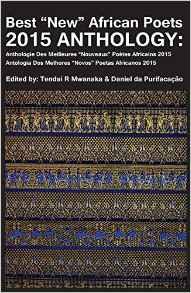
The Best “New” African Poets Anthology can be purchased at http://amzn.to/1mwo3Go 
 
Mike Kantey sente o que diferencia o BNAP de todos os outros livros de poesia é porque todos os grupos de nós em um livro , promove o espírito de africanism pan e nos faz sentir mais perto de si

1)     Who /what introduced you to poetry?
            MK: Poetry was always in my life: from the earliest nursery rhymes to the popular songs   on radio.

2)     What kind of poetry/ storytelling tradition exist in your culture/country and has this had any bearing on your writing?
MK: Being a multilingual country with many cultures from all over the world, I have been exposed throughout my life to many voices and many traditions, so that I was led to study not only English at the University of Cape Town, but also Greek & Roman Literature and Philosophy and Religious Studies and I also majored in the African Languages. As a result, all of my work is conscious of the variety of human experience and culture, and all my writing is multi-voiced and multi-cultural in spirit and expression.

3)     What attracted you to writing books for children and how does your approach to writing change when you’re writing for adults?
MK: I have always been attracted to children’s literature and often collected award-winning literature from all over the world. I then worked as a publisher in the nine African languages of Southern Africa, with a high percentage in the first few years of mass schooling, so it was natural for me to write for that audience. I guess the difference lies in the simplicity of both the story and the language, the greater element of surprise and fun.
Great stories for children are like great jokes: short and to the point. Novels and narratives (like All Tickets, Touching Circles, and Touching Hands) are like choo-choo trains: a bunch of little stories all strung together and a little bit drawn out.

4)     What urban influences have influenced your writing?
MK: The biggest influence in my life has been the City of Cape Town, although I am familiar with many others through the power of literature, TV, radio, and film, and by visiting (among others) Paris, Rome, London, Amsterdam, New York, and San Francisco.

5)     How have you been able to interlink your love for poetry and your love for environmental (and other forms of) activism?
MK: Some of my poems are expressly political, some are obviously talking about environmental themes, but I am more likely to talk about the tinier details of the environment (like a bee tumbling within a flower), some influence of Chinese and Japanese poetry, and more importantly about my ever-abiding love of particular women in my life at a particular time in the past (and – of  course – my current partner), which I guess owes tribute to the tradition of love poetry and troubadours throughout the world.

6)     As a writer who also has experience with editing, what do you think sets the BNAP anthology from other African anthologies?

MK: Obviously, the wide selection from different countries is what sets this anthology apart, but also I think the spirit of Pan-Africanism: the idea that we are all brothers and sisters in one sub-Continent, or region of Africa, and therefore it helps me to feel closer to those of my brothers and sisters in the north.

Tuesday, January 26, 2016

IN DEPTH INTERVIEWS SERIES: Week of 25 January 2016

An Interview with the poets Chaun Ballard and Samantha Akwei a.k.a Brok'N Sylance

African Writing from the Diaspora
When “African literature” rose in popularity in the 1960’s times where much simpler: the great writers of the time had been born and raised on the continent and the issues they tackled could easily be identified as “African problems.” Fast forward to the 21st century and now there are many writers of African descent who are writing outside Africa’s borders. The recent anthology of African poetry edited by Tendai Mwanaka and Daniel da Purifacação has included voices from over 23 African nations and their respective diasporas.
Tariro Ndoro speaks to contributing poet, Chaun Ballard, about poetry, forms and writing in the diaspora.

TN : How long have you been in the poetry game?
CB: I have been exploring the art of poetry for five years now, which is still relatively a short time. In many ways I still feel like an infant. I am currently entering my fourth year of graduate study, and I am working toward my Master of Fine Arts at the University of Alaska, Anchorage’s Creative Writing and Literary Arts Program.

TN: What kind of poetry/ storytelling tradition exist in your culture/country and has this had any bearing on your writing?
CB: In the US, we typically focus on the use of forms. Explorations of traditional forms and finding ways to deliver modern content within those restraints are some of the approaches that literary magazines and journals seem attracted to. In addition to “taking the old and making it new,” the US has really embraced poetry written from spoken language. I can write in my dialect, with all of its historical connotations, and that is welcomed. As far as my own poetic content, it mostly consists of finding the right metaphor to express my past and present experiences.


TN: What urban influences have influenced your writing?
CB: I have been influenced by all of the above (hip hop and slam poetry) subconsciously. The trick is finding the right way to include a broader audience. One way to do that is through the use of forms.

TN: What style of writing (free verse, lyrical etc) do you lean towards?
CB: I have to say, currently, I am tinkering with both. Really though, the poem does the deciding for me. I may sit down to write a formal lyric poem, and it will come out as a Bardic free verse, or vice versa.

TN: Which writers have influenced your writing?
CB: I’m always in search for that poem that resonates. I’m in constant search of that “Wow!” moment. I have too many poets I enjoy—many more I have yet to discover. Currently I am reading Zeina Hashem Beck, but in the past I have found inspiration from Kwame Dawes, Patricia Smith, Linda McCarriston, Terrance Hayes, Yehuda Amichai, Yehoshua November, Fady Joudah, Agha Shahid Ali,  Edward Kamau Brathwaite, Pablo Neruda, Kahlil Gibran, Danez Smith, Tarfia Faizullah, Tara Ballard (my wife)…the list goes on.

TN: How has writing in the diaspora influenced you writing?
CB: As a poet of the diaspora, I often find myself attracted to poetry that either expresses moments in transit, of longing, forced or reinforced settlement. Visiting the places that my family has come from has helped to broaden my perspective on history and colonizers. My poetry seeks to marry to two, literally and metaphorically.

TN: In what ways have you used poetry to engage with your community?
CB: As with anything a poet writes, my hope is that it will encourage readers to take a second look at what is being addressed—the content and its purpose—even if it is from a different angle or perspective.

TN: Which emerging African writers do you think will make it big in the next 10 years and why?
CB: That is a great question, and a difficult one to answer because there are so many new and fresh faces out right now. In the US, I believe we are witnessing an emergence in the realm of “queer poetry,” especially in the African American poetry community. I believe that much of the strong and new poetry coming out are from those like Danez Smith and Cameron Awkward-Rich. I think their challenge, like many of our challenges, will be to resist the categorization of their poetry that may limit their readership.
TN: How do you think this anthology changes the face of modern African writing?

I believe what this anthology has set out to accomplish, and is accomplishing, both for the continent of Africa and the diaspora is ambitious and necessary. At its most basic level, The Best “New” African Poets 2015 Anthology looks to creates a contextual dialogue between continental Africans as well as with Africans of the diaspora. In a much broader sense, it unites all those of continental descent, whether localized, and of the diaspora, through our “deal[ing] with a panoply of issues, feelings, thoughts, ideas, beliefs..., on identity, Africanness (Blackness, Whiteness, Arabic, Asian...), culture, heritage, place, politics, (mis)governance, corruption, exile, loss, memory, spirituality, sex, gender, [and] love...” Through this anthology we are made known to one another, both visibly and audibly, and, as with all things written, this anthology creates a lasting platform to address various issues spurred by open dialogue. It is proper and right that such an ambitious endeavor has risen out of the continent of Africa herself—this anthology is the response of her children and their ideas about place and home.

Chaun Ballard was raised in both Missouri and California. For six years now, he and his wife have been teaching in the Middle East & West Africa. He is currently a graduate student in the University of Alaska, Anchorage’s MFA Program. He’s had poems recently accepted by Apogee, The Caribbean Writer, Grist: The Journal for Writers, Sukoon, Orbis: Quarterly International Literary Journal, Off the Coast, and other literary magazines. His photos can be seen in the latest issues of Gravel and The Silk Road Review.

The Best “New” African Poets Anthology can be purchased at http://amzn.to/1mwo3Go 

Brok’N Sylance

“I was introduced to poetry when at the age of 8,” says New York poet Brok’N Sylance, “when my second grade teacher; Sharon Taberski read a poem to start each day. Above every other assignment, I looked forward to the free form of the words and the rhythm and sound of each line.” A year later she wrote her first poem and a year after that she penned her first poetry anthology as a part of a class assignment. It was not until I got into high school that I was moved to join the spoken word scene. Growing up in Harlem, in the late 80’s, early 90’s introduced Brok’N Sylance to  Hip Hop and was a pivotal part of her relationship with the spoken word tradition: “I enjoyed watching music videos, free style battles and anything lyrically based that required an artist to purposefully choose their words in order to convey a certain point. I was blown away by their craft.” 2pac, Biggie, Eve and Lauryn Hill were some of the MCs she looked up to. Spoken word hasn’t just been a mouthpiece for Brok’N Sylance but has also allowed her to step into different communities and be the change, “spoken word poetry awakened me to becoming more engaged with my community. I would be hired by an organization just to share a poem about a particular issue and then would end up volunteering. I did not just want to talk about the change I wanted to see but began to realize that I needed to be actively engaged as well.”
As a girl growing up in a family of immigrants, she first felt an awareness of not belonging when she saw her grandmother struggle with language barriers, “I would have spoken more about language barriers, what it is like having to transform into another human in order to become a part of. I caught on early even when my grandmother spoke no English. I saw how she struggled, how she was respected and I told myself that was not going to happen to me but still quietly, I admired her strength. Sadly, I do not know enough major African writers and I will blame my Eurocentric education for that. Ironically as a first generational Ghanaian, my parents did not speak much of our oral tradition but as I was in college, I began to look deeper at its comparisons especially through spoken word. However, I am proud of Best “New” African Poets Anthology and the poets that have dared to share their soul and look forward to supporting their work in the future.”

The Best “New” African Poets Anthology can be purchased at http://amzn.to/1mwo3Go